

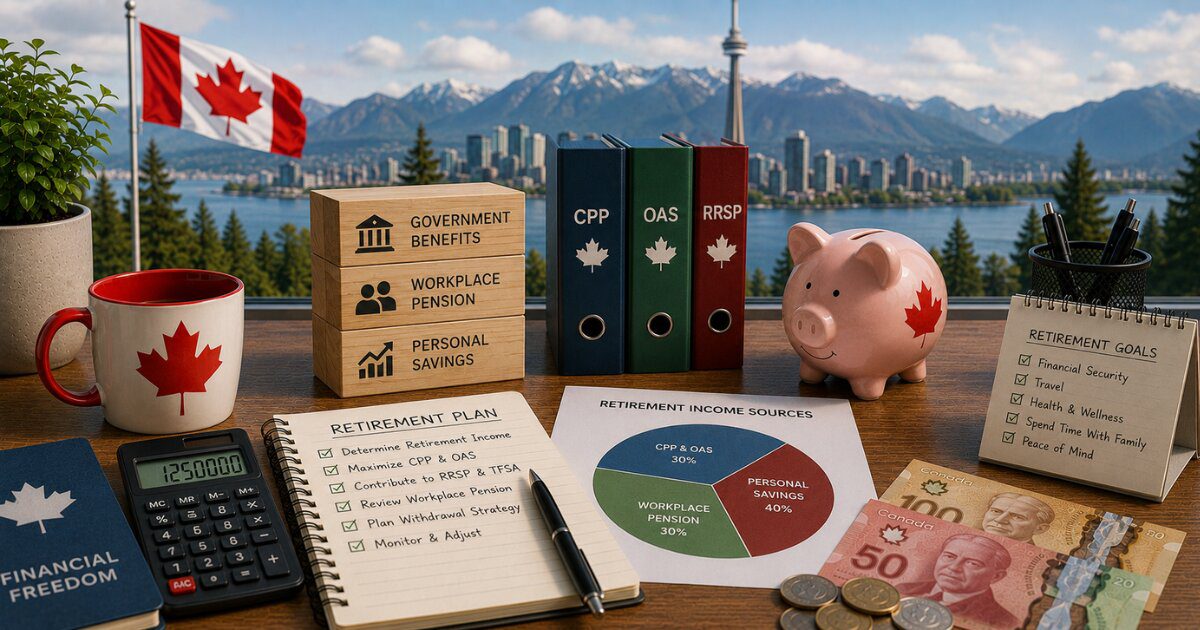
Planning for retirement in Canada involves navigating a combination of government benefits, employer pensions and personal savings accounts, all with their own rules, timelines and tax implications. Understanding how these pieces fit together allows you to make decisions today that will have a dramatic impact on your financial security in retirement.
This guide explains the Canadian retirement system from CPP to RRSP to OAS, and how to build a plan that works for your situation.
The Three Pillars of Canadian Retirement Income
Canada’s retirement income system is built on three main sources of income, often described as the three pillars.
The first pillar is government benefits: the Canada Pension Plan (CPP) and Old Age Security (OAS). These are the foundation that most Canadians receive simply by virtue of having worked and lived in Canada.
The second pillar is employer pensions. Canadians who work for governments, large corporations or unionised employers often have defined benefit or defined contribution workplace pensions.
The third pillar is personal savings: RRSP, TFSA, FHSA and non-registered investments. This is where individual decisions have the greatest impact.
Canada Pension Plan (CPP)
The CPP is a mandatory earnings-based pension that virtually all employed Canadians contribute to throughout their working lives. Both you and your employer each contribute 5.95 percent of your pensionable earnings (up to the Year’s Maximum Pensionable Earnings) to CPP.
The amount you receive from CPP in retirement depends on how much you contributed over your working life and when you start taking payments.
The standard age to begin CPP is 65. You can start as early as age 60, but your monthly payment is reduced by 0.6 percent for each month before 65 you start, meaning starting at 60 reduces your payment by 36 percent permanently. Conversely, delaying CPP beyond 65 increases your monthly payment by 0.7 percent per month, meaning waiting until 70 gives you 42 percent more per month than starting at 65.
The maximum monthly CPP payment at age 65 in the current year is approximately CAD 1,300. Most Canadians who did not contribute the maximum throughout their career receive substantially less than this.
Old Age Security (OAS)
OAS is a universal government pension available to most Canadians aged 65 and older who have lived in Canada for at least 10 years after age 18. Unlike CPP, OAS is not based on your work history. Full OAS requires 40 years of Canadian residence after age 18.
The maximum monthly OAS payment is approximately CAD 700 at age 65. You can defer OAS until age 70, with each month of deferral increasing your payment by 0.6 percent. Deferring from 65 to 70 increases your OAS by 36 percent permanently.
For higher-income retirees, OAS is partially or fully clawed back. The OAS clawback begins when individual net income exceeds approximately CAD 90,000 per year, with full clawback occurring above approximately CAD 150,000.
Guaranteed Income Supplement (GIS)
Low-income OAS recipients may also qualify for the Guaranteed Income Supplement, which provides additional monthly income. GIS is income-tested and reduces as other income increases. It is designed to ensure no Canadian senior lives in severe poverty.
RRSP and Retirement
Your Registered Retirement Savings Plan is one of the most powerful retirement savings tools available to Canadians. Contributions reduce your taxable income in the year of contribution, and growth inside the RRSP is tax-deferred until withdrawal.
You must convert your RRSP to a Registered Retirement Income Fund (RRIF) by the end of the year you turn 71. Once converted to a RRIF, you must withdraw a minimum amount each year, calculated as a percentage of your RRIF balance at the start of the year. These withdrawals are fully taxable as income.
The tax efficiency of an RRSP comes from contributing during high-income working years and withdrawing during lower-income retirement years, paying tax at a lower marginal rate.
How Much Do You Need to Retire in Canada
A commonly used guideline is that you need roughly 70 to 80 percent of your pre-retirement income to maintain your lifestyle in retirement. However, this varies significantly depending on your planned lifestyle, whether you own your home outright, your health expenses and your specific goals.
Using CPP and OAS as a base, most Canadian couples can expect approximately CAD 30,000 to CAD 45,000 per year combined from government benefits. If your desired retirement income is CAD 70,000 per year as a couple, you need your own savings to generate approximately CAD 25,000 to CAD 40,000 per year.
Using a 4 percent withdrawal rate as a planning guideline, generating CAD 30,000 per year from savings requires a portfolio of approximately CAD 750,000.
When to Start CPP and OAS: The Key Decision
One of the most consequential retirement decisions Canadians face is when to start CPP and OAS. The optimal timing depends on your health, other income sources and life expectancy.
If you expect to live a long life, delaying both CPP and OAS to 70 is often the best mathematical outcome. The break-even point versus starting at 65 is typically around age 82 to 83. If you live beyond that age, the deferred strategy wins.
If you have a shorter life expectancy or need the income immediately in retirement, starting at 65 or even 60 may be more appropriate.
Defined Benefit Pensions in Canada
Canadians who work in the public sector, government or certain large private employers may have access to a defined benefit pension, which guarantees a specific monthly income in retirement based on years of service and final salary. These pensions are increasingly rare in the private sector but remain common for federal and provincial government employees, teachers, police officers and healthcare workers.
If you have a defined benefit pension, factor this into your retirement income projections before determining how much additional RRSP and TFSA saving you need.
Frequently Asked Questions
At what age can I retire in Canada?
There is no mandatory retirement age in Canada. CPP can start as early as 60. OAS starts at 65. You can retire at any age if your savings and income sources are sufficient.
How much CPP will I receive in Canada?
Your CPP amount depends on your contribution history. Check your My Service Canada Account to see your estimated CPP entitlement based on your actual contribution record.
Is CPP enough to retire on in Canada?
For most Canadians, CPP and OAS together are not sufficient to maintain their pre-retirement lifestyle. Personal savings through RRSP, TFSA and employer pensions are essential supplements.
What happens to my RRSP when I retire in Canada?
You must convert your RRSP to a RRIF by the end of the year you turn 71. Alternatively, you can collapse the RRSP and take the full amount as cash, though this triggers a large tax bill. Most retirees gradually draw down the RRSP or RRIF over retirement.
Should I take CPP early or late in Canada?
If you are healthy and expect to live past age 82 or 83, delaying CPP to 70 for the 42 percent increase is typically the better financial decision. If health concerns exist or you need income immediately, starting earlier makes sense.
How does RRSP withdrawal affect OAS clawback?
RRSP and RRIF withdrawals count as taxable income. If your total income in retirement exceeds approximately CAD 90,000, OAS begins to be clawed back. This is a reason some financial planners recommend drawing down RRSPs strategically in years between retirement and age 65 when OAS begins.
This article is for educational purposes only and does not constitute financial advice. CPP and OAS amounts and rules change regularly. Please consult a qualified financial planner or Service Canada for advice specific to your situation.