

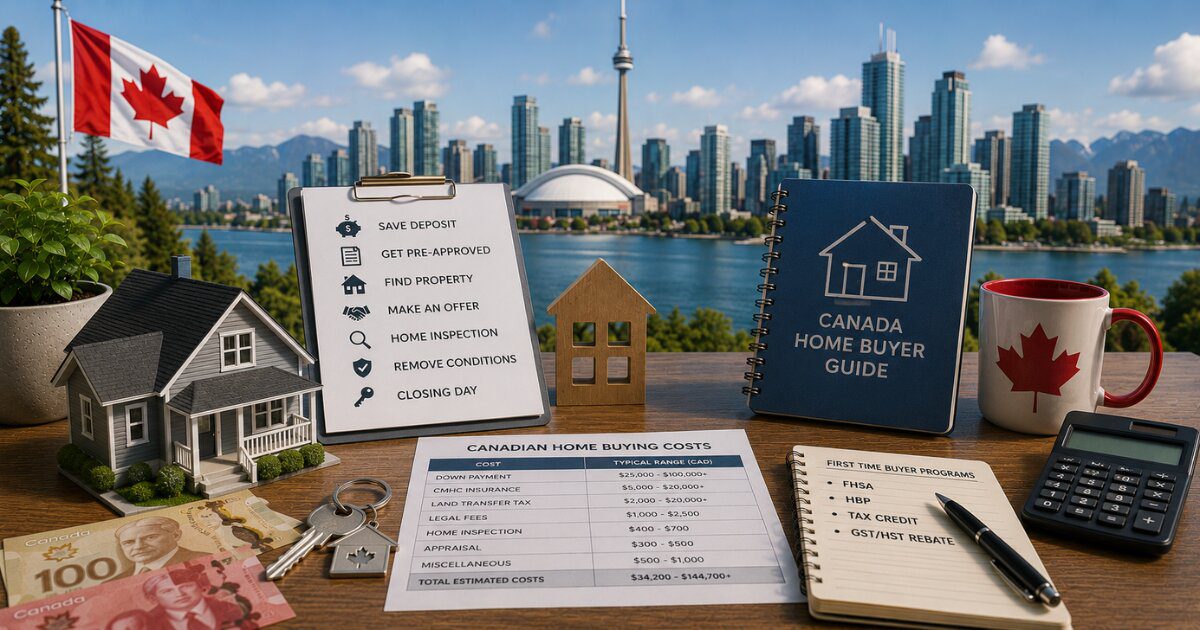
Buying a home in Canada is a major financial commitment in one of the world’s most expensive housing markets. Vancouver and Toronto consistently rank among the least affordable cities globally, while Calgary, Edmonton, Ottawa and Atlantic Canada offer more accessible entry points. Understanding the buying process, government programs and true costs before you start searching saves you time and money.
The Canadian Housing Market
Canada’s housing market has experienced significant price growth over the past two decades, with particularly sharp increases in major urban centres. The Bank of Canada’s interest rate decisions have a direct impact on mortgage rates and therefore on housing affordability. Understanding whether you are buying in a buyer’s market or a seller’s market in your specific city is important context for how aggressively to bid.
Minimum Down Payment Requirements in Canada
The minimum down payment in Canada depends on the purchase price. For homes costing up to CAD 500,000, the minimum down payment is 5 percent. For the portion of a home’s price between CAD 500,000 and CAD 1,499,999, the minimum down payment is 10 percent. For homes costing CAD 1,500,000 or more, the minimum down payment is 20 percent and mortgage default insurance is not available.
Down payments below 20 percent require CMHC (Canada Mortgage and Housing Corporation) mortgage default insurance, which is a premium of 2.8 to 4 percent of the mortgage amount added to your loan. While this increases your mortgage, it allows you to enter the market sooner with a smaller deposit.
Government Programs for Canadian Home Buyers
First Home Savings Account (FHSA)
The FHSA is one of the most powerful tools available to Canadians saving for their first home. You can contribute CAD 8,000 per year to a maximum of CAD 40,000 lifetime. Contributions are tax-deductible like an RRSP, and withdrawals for a qualifying home purchase are completely tax-free like a TFSA. This combination makes the FHSA the priority account for first-time buyers in Canada.
Home Buyers’ Plan (HBP)
The Home Buyers’ Plan allows first-time buyers to withdraw up to CAD 60,000 from their RRSP tax-free to use as a down payment. If both you and your partner qualify as first-time buyers, you can withdraw a combined CAD 120,000. The withdrawn amount must be repaid to your RRSP over 15 years, or it is included in your taxable income.
First-Time Home Buyers’ Tax Credit
This federal tax credit provides up to CAD 1,500 in tax relief in the year you purchase your first qualifying home.
GST/HST New Housing Rebate
If you buy a newly built home, you may be eligible for a partial rebate of the GST or HST paid on the purchase price.
The Mortgage Stress Test in Canada
All Canadian mortgage applicants must pass the stress test, which tests your ability to make mortgage payments at the higher of your contracted rate plus 2 percent, or 5.25 percent. This means even if you are approved for a mortgage at a lower rate, you must demonstrate you can afford payments at the stress test rate. This significantly affects how much you can borrow.
The Canadian Home Buying Process
Get a mortgage pre-approval before you start house hunting. A pre-approval tells you exactly how much you can borrow and shows sellers you are a serious buyer.
Work with a real estate agent (called a REALTOR in Canada). In most Canadian provinces, the seller pays the real estate commission for both agents, meaning using a buyer’s agent costs you nothing directly.
Make an offer when you find a property you want to buy. Your agent will help you draft an offer to purchase, which includes the price, deposit amount and conditions such as financing and home inspection.
If your offer is accepted with conditions, you typically have five to ten days to complete your financing and home inspection. If either reveals a problem, you can withdraw from the transaction and receive your deposit back.
Once conditions are waived, the transaction is firm. Your lawyer handles the closing, transfers funds to the seller and registers the property in your name.
Land Transfer Tax in Canada
Most Canadian provinces charge a land transfer tax on property purchases. Ontario charges a provincial land transfer tax of 0.5 to 2.5 percent depending on purchase price, with Toronto buyers paying an additional municipal land transfer tax of the same amount. First-time buyers in Ontario can receive a rebate of up to CAD 4,000 on provincial LTT and a separate rebate on the Toronto LTT.
British Columbia, Quebec, Manitoba and PEI also charge land transfer taxes. Alberta and Saskatchewan do not charge a land transfer tax, making them more affordable from a transaction cost perspective.
Frequently Asked Questions
How much does it cost to buy a house in Canada beyond the purchase price?
Budget for land transfer tax, lawyer fees of CAD 1,500 to CAD 3,000, home inspection costs of CAD 400 to CAD 700, CMHC insurance if your down payment is below 20 percent, title insurance and moving costs.
What is the CMHC mortgage stress test?
All Canadian mortgage applicants must qualify at a minimum rate of 5.25 percent or their contracted rate plus 2 percent, whichever is higher, regardless of their actual mortgage rate. This ensures borrowers can handle rate increases.
Can non-residents buy property in Canada?
The foreign buyer ban introduced in 2023 restricts most non-Canadians from buying residential property in Canada until 2027, with some exceptions for permanent residents, certain workers and students.
How long does it take to buy a house in Canada?
From accepted offer to closing, most Canadian transactions take 30 to 90 days, with 60 days being typical.
This article is for educational purposes only and does not constitute financial or legal advice. Rules and programs change regularly. Please seek professional advice specific to your situation.