

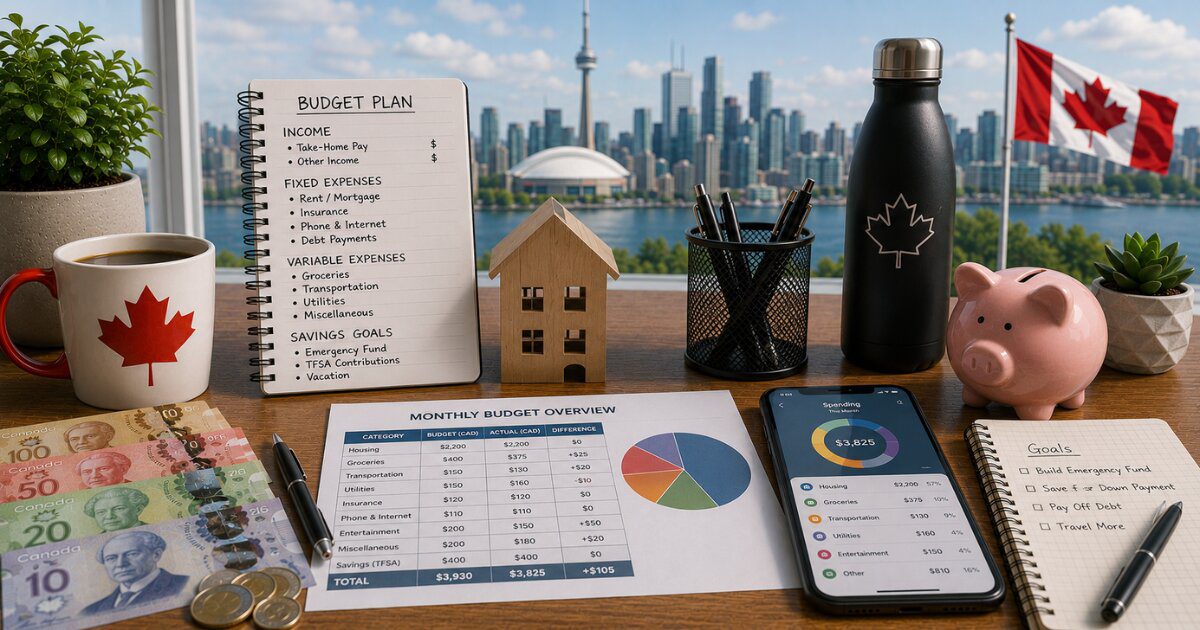
Canada offers an excellent quality of life, but the cost of living in major cities like Toronto and Vancouver has risen sharply. Building a budget that works for your Canadian lifestyle is more important than ever, whether you are trying to save for a down payment, pay off student loans, build your TFSA or simply feel more in control of your money.
Understanding Your Canadian Income for Budgeting
Build your budget around your net take-home pay after federal and provincial income tax, CPP contributions and EI premiums. Your pay stub clearly shows these deductions.
For self-employed Canadians, estimate your net income conservatively, accounting for both employee and employer portions of CPP and your full income tax liability. Setting aside 25 to 30 percent of gross self-employment income for taxes is a sensible starting point.
Canadian Cost of Living Benchmarks
Rent varies dramatically by city. In Toronto, a one-bedroom apartment in the downtown core typically costs CAD 2,200 to CAD 3,000 per month. In Vancouver, similar pricing applies. In Calgary and Ottawa, one-bedroom apartments range from CAD 1,400 to CAD 2,000. In smaller cities and rural areas, costs are significantly lower.
Monthly groceries for a single Canadian adult average CAD 300 to CAD 450. For a couple, CAD 500 to CAD 750 is typical. No-name brand products at Loblaws and Superstore, or shopping at FreshCo and Food Basics, can reduce grocery costs meaningfully.
Transportation costs depend heavily on whether you own a vehicle. Car ownership in Canada including insurance, fuel, maintenance and financing typically costs CAD 700 to CAD 1,200 per month. Major Canadian cities have transit systems that represent a far cheaper alternative at CAD 100 to CAD 160 per month for a transit pass.
A Practical Canadian Budget Framework
A simple framework that works for most Canadian households divides spending into three categories.
Fixed expenses include rent or mortgage, car loan or lease payments, insurance premiums, phone plan, internet, and minimum debt payments. These come out first and are largely non-negotiable in the short term.
Variable necessary expenses include groceries, transit or gas, utilities and household supplies. These vary month to month but are essential. Track actual spending in these categories for two months before setting budget targets.
Discretionary spending includes dining out, entertainment, clothing, travel, hobbies and subscriptions. This is where most Canadians find the biggest opportunities to adjust spending without meaningfully affecting their quality of life.
TFSA as a Budgeting Tool
One of the most powerful budgeting strategies for Canadians is to automate TFSA contributions on payday. By transferring a fixed amount to your TFSA the moment your pay arrives, before you have a chance to spend it, you make saving automatic and consistent.
Even CAD 200 per month into a TFSA invested in a broad market ETF like XEQT builds into a significant sum over time. The tax-free growth means every dollar compounds uninterrupted by the CRA.
Read our guide to the best TFSA ETFs in Canada for ideas on how to invest your TFSA contributions.
Reducing Common Canadian Expenses
Phone plans are significantly more expensive in Canada than in most comparable countries. Shopping at budget carriers like Fido, Koodo, Public Mobile or Freedom Mobile typically saves CAD 30 to CAD 60 per month compared to full-price plans from Rogers, Bell and Telus.
Car insurance varies enormously by province and driving record. Getting quotes from multiple insurers annually through a broker or comparison site typically saves CAD 200 to CAD 600 per year.
Grocery shopping strategies include using Flipp to compare weekly flyer deals, buying store brand products, purchasing proteins and pantry staples in bulk at Costco, and using the PC Optimum program at Loblaws and Shoppers Drug Mart.
Frequently Asked Questions
What is a realistic budget for a single person in Toronto?
A realistic minimum monthly budget for renting in Toronto is approximately CAD 4,000 to CAD 5,500 including rent, food, transit and basic living expenses.
What budgeting apps work in Canada?
Mint (operated by Intuit), YNAB, and Wealthsimple’s built-in spending tracker all work in Canada. Many Canadian banks including RBC, TD and Scotiabank have improved their own app-based spending tracking significantly.
How should I budget for saving a house deposit in Canada?
Calculate your target deposit, add the timeframe you want to achieve it in, and divide to get a monthly savings target. Open an FHSA and TFSA first, as both offer tax advantages for first home savings.
How much should Canadians save for retirement each month?
A widely cited guideline is 10 to 15 percent of gross income toward retirement. Maximising employer pension matching and RRSP contributions should be the priority before investing in taxable accounts.
This article is for educational purposes only and does not constitute financial advice.