

Buying property in Ireland is one of the most significant financial decisions an Irish person will make. With Dublin consistently ranking among the most expensive cities in the eurozone for property, and with supply constraints that have made the market highly competitive, understanding the process thoroughly before you begin is essential.
The Irish Property Market
Ireland faces a persistent housing shortage that has kept property prices elevated relative to incomes. Dublin prices are particularly high, with average prices for a three-bedroom semi-detached house in many Dublin suburbs exceeding EUR 400,000 to EUR 600,000. Cities like Cork, Galway and Limerick offer somewhat more affordable entry points, while rural Ireland remains significantly cheaper.
First-time buyers compete with investors, cash buyers and returning emigrants in a market where supply has consistently fallen short of demand. Government schemes and Central Bank mortgage rules shape what buyers can borrow and how they access the market.
Central Bank Mortgage Lending Rules in Ireland
The Central Bank of Ireland imposes strict limits on mortgage lending. First-time buyers can borrow up to four times their gross annual income. Second and subsequent buyers can borrow up to three and a half times their gross income.
On the deposit side, first-time buyers must provide a minimum deposit of 10 percent. Second and subsequent buyers must provide at least 20 percent. A limited number of exceptions to these rules are permitted for each lender annually.
For a first-time buyer couple earning a combined EUR 100,000 and borrowing at four times income, the maximum mortgage is EUR 400,000. With a 10 percent deposit of EUR 40,000, the maximum purchase price is EUR 444,000.
Government Schemes for Irish First Time Buyers
Help to Buy (HTB) Scheme
The Help to Buy scheme provides a refund of income tax and DIRT paid over the previous four years, up to EUR 30,000 or 10 percent of the purchase price of a new build home, whichever is lower. The property must be a new build and must cost no more than EUR 500,000. This scheme has been a significant help for Irish first-time buyers purchasing new homes.
First Home Scheme
The First Home Scheme is a shared equity scheme where the government and participating banks take a combined equity stake in your home in exchange for funding a portion of the purchase price. This reduces the mortgage amount required. The scheme is available for new and second-hand homes up to certain price limits that vary by county.
Local Authority Home Loan (LAHL)
The Local Authority Home Loan provides mortgages to first-time buyers and certain other buyers at competitive fixed interest rates. It is specifically designed for applicants who have been refused mortgages by two commercial lenders. Income caps and property price limits apply by county.
Stamp Duty on Irish Property
Stamp duty in Ireland is charged at 1 percent on residential property up to EUR 1,000,000. The portion above EUR 1,000,000 is charged at 2 percent. Unlike the UK, Ireland does not offer stamp duty exemptions for first-time buyers, though the Help to Buy and First Home schemes effectively reduce the deposit requirement instead.
The Irish Property Buying Process
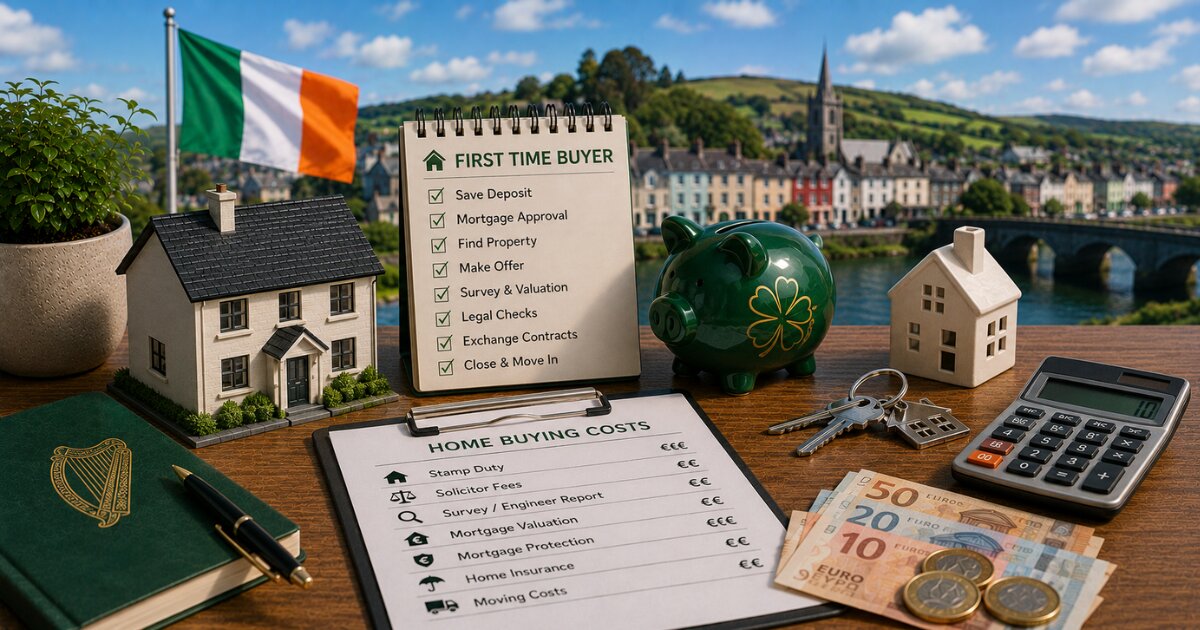
Before searching for properties, get a mortgage Approval in Principle (AIP) from your lender. This tells you how much you can borrow and demonstrates to estate agents and sellers that you are a serious buyer.
Use Daft.ie and MyHome.ie, Ireland’s two main property portals, to search for properties. Attend viewings and engage a solicitor before making an offer.
When you find a property, make an offer through the estate agent. Property sales in Ireland are conducted by estate agents representing the seller. Your offer is not legally binding at this stage.
If your offer is accepted, both sides appoint solicitors. Your solicitor conducts due diligence including reviewing the title, local authority searches, planning history and any charges on the property.
Contracts are exchanged once the legal work is complete, at which point you pay a booking deposit of 10 percent of the purchase price. This makes the transaction legally binding.
Completion occurs when the remaining funds are transferred and the keys are handed over. For a new build, this may be months after contracts are signed.
Costs of Buying Property in Ireland
Beyond the purchase price, budget for: stamp duty (1 percent of purchase price up to EUR 1 million), solicitor’s fees of EUR 1,500 to EUR 3,000 plus VAT, surveyor/engineer report of EUR 250 to EUR 500, mortgage valuation of EUR 150 to EUR 200, mortgage protection insurance (required by lenders), home insurance and moving costs.
Frequently Asked Questions
How much deposit do I need to buy a house in Ireland?
First-time buyers need a minimum 10 percent deposit under Central Bank rules. The Help to Buy scheme can contribute up to EUR 30,000 toward this deposit for new builds.
What is the Help to Buy scheme in Ireland?
HTB provides a refund of up to EUR 30,000 in income tax and DIRT paid over four years for first-time buyers purchasing or self-building a new home costing up to EUR 500,000.
How long does it take to buy a house in Ireland?
From offer accepted to completion typically takes two to four months for a straightforward transaction, though complex title issues or new builds can take significantly longer.
Do I need a solicitor to buy property in Ireland?
Yes. Conveyancing in Ireland is handled by a solicitor. This is not optional.
Is it a good time to buy property in Ireland?
Market timing is inherently uncertain. The most relevant question is whether the purchase is affordable relative to your income and whether you plan to stay in the property for at least five to seven years.
This article is for educational purposes only and does not constitute financial advice. Property rules and schemes change regularly. Please seek professional advice.